
Golden Grass
The capim dourado is a Brazilian plant whose fine stems have a naturally golden color. Its name means “golden grass” in Portuguese; its golden hues have also earned it the nickname vegetal gold. In Jalapão, in the heart of Brazil, artisans transform this lightweight material into jewelry and objects using skills passed down from generation to generation.
From plant to jewelry, discover what makes capim dourado so unique: its origin, how it is harvested, the work of the artisans, and simple ways to care for it.
Would you like to discover these creations? Browse our selection of Capim Dourado jewelry.
As you scroll through this page
- A naturally golden plant
- Jalapão, a land of craftsmanship
- From harvest to jewelry
- A resource to preserve, a craft to pass on
- Choosing your capim dourado jewelry
- How to care for it
A naturally golden plant
The golden color of capim dourado comes from the plant itself: the stems are neither painted nor dyed to achieve this color. When assembled, they create fine, luminous lines that give the jewelry its characteristic texture and golden hues.
The nickname “vegetal gold” describes the appearance of Capim Dourado: this material is not metallic gold. However, some pieces of jewelry may contain metal elements, particularly for the clasps, fasteners, or supports.
Its scientific name is Syngonanthus nitens. Despite its name “golden grass,” this plant belongs to the Eriocaulaceae family. Artisans use its flowering stems: these are the long stems that bear the small flowers above the leaves, which grow close to the ground.
This material is equally suited to clean lines and more elaborate shapes. Depending on the design, it can be worn on its own or paired with natural stones, beads, and other elements.
Jalapão, a land of craftsmanship
In the state of Tocantins, Jalapão is one of the birthplaces of capim dourado craftsmanship. The plant grows in the wetlands of the Cerrado, Brazil’s vast savanna region, particularly near the veredas, where buriti palms grow.

The history of this craft is closely linked to Mumbuca, a quilombola community in Jalapão. The work with capim dourado is passed down through generations there and plays an important role in local life. Over time, the techniques inherited from elders have evolved to create new forms, from everyday objects to jewelry.
Each creation reflects this craftsmanship: selecting the stems, gathering them, designing a curve, and maintaining its shape. Behind the lightness of a piece of jewelry lies patient, precise work.
From harvest to jewelry
1. Harvesting the stems when they are mature

Capim dourado is harvested when its stems are mature, dry, and golden. Their color is already present in the fields. The seed heads are separated from the stems and left at the harvest site to help the plant regenerate.
2. Selecting and preparing the material
After harvest, the stems are gathered into bundles and sorted to select those suitable for artisanal work. Their fineness, flexibility, and uniformity are important when creating a design: a delicate little curve and a larger piece require different assembly techniques.
3. Shaping and assembling the stems
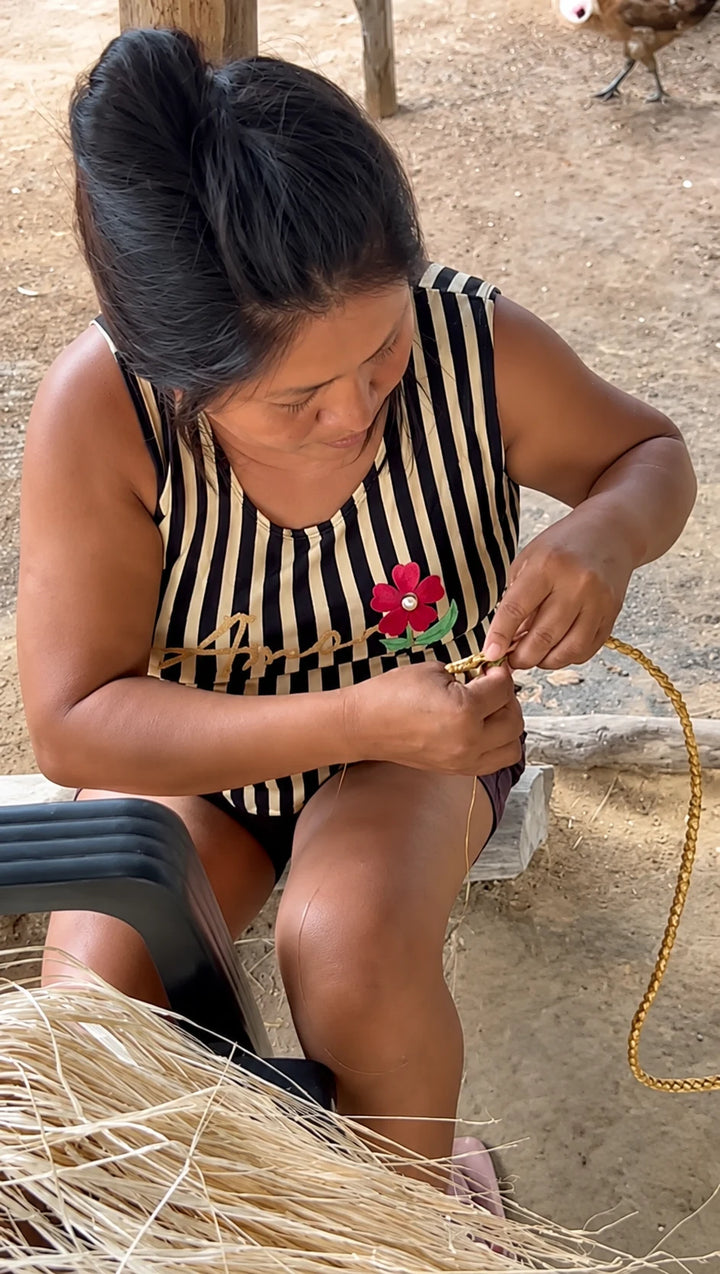
Artisans gather the stems into small bundles, then bend, coil, or intertwine them to create the desired design. In the traditional technique, they are sewn together with a fiber made from the young leaves of the buriti palm, known as “buriti silk.” The stitches hold the stems together as the shape takes form.
Some designs also include a fine metal support hidden inside the assembly to help the jewelry retain its shape.
Intertwined circles, twists, braided balls, or concentric lines: the same material can be used to create very different pieces of jewelry. The word “braiding” aptly describes this craft, but sewing and assembly also play essential roles.
4. Adding the finishing touches
The capim dourado piece is then assembled with the other elements of the jewelry: clasps, fasteners, chains, beads, or natural stones. These combinations give each design its own character, from understated jewelry to more striking pieces.
Subtle variations in color, shape, or braiding may appear from one creation to another. They are part of the charm of a natural material crafted by hand.
A resource to preserve, a craft to pass on
Capim dourado harvesting is subject to regulations designed to preserve the plant and ensure the long-term survival of this craft. In Tocantins, the 2019 law dedicated to capim dourado and buriti provides for a harvest period from September 20 to November 30, when the stems have reached maturity.
Harvesting practices require leaving the seeds in place and preserving the plant’s root system in the soil. These practices promote regeneration and make it possible to continue working with this resource throughout the seasons.
This craft thus links knowledge of the plant, the preservation of its environment, and the activities of local communities. Research conducted with artisans and researchers sheds light on these practices and their role in conserving the resource.
Choosing a capim dourado creation also means appreciating a plant-based material for its natural beauty and making room for a craft passed down through generations.
Choosing your capim dourado jewelry
Capim dourado captivates with its warm golden hues and lightness. It allows you to wear generous shapes without the plant material feeling heavy. However, the weight of the jewelry depends on its size and the other elements that make it up: some designs adorned with several natural stones, for example, are heavier than those made primarily from capim dourado.
To choose yours, let yourself be guided by the shapes you like: fine lines for a subtle touch, more substantial shapes to complement an outfit, or stones to add color. The golden hues pair well with both natural tones and deep colors.
At Auri Nativa, several collections showcase these variations:
- Capim dourado earrings: delicate or more sculptural shapes, sometimes paired with natural stones.
- Capim dourado bracelets: fine or wider designs, multi-row braiding, cuffs, and stone combinations.
- Capim dourado necklaces: minimalist pendants or more elaborate designs to adorn the neckline.
- Capim dourado rings: small golden designs or more substantial pieces that catch the eye.
Our jewelry is handmade in Brazil and shipped from France.
How to care for capim dourado jewelry
A few simple steps help preserve the shine and shape of your jewelry:
- Avoid prolonged contact with water, perfumes, creams, cosmetics, and household products.
- Clean it gently with a soft, dry cloth.
- Store it in a dry place, away from moisture and direct light.
- Store it without bending, pulling, or crushing it, preferably separately from other jewelry.
If it gets wet, gently blot it with a dry cloth, then leave it to air-dry before storing it. Do not use a hairdryer or radiator to speed up drying, and avoid using metal cleaners on the plant material.
With careful maintenance, you will be well-positioned to enjoy your jewelry for a long time. How well it holds up over the years depends particularly on how often you wear it and how well you care for it.
For practical questions about jewelry, orders, or delivery, visit the Auri Nativa FAQ. And if you are choosing between two designs, write to us: we will be happy to help you choose.